
Knife Valve
Knife gate valve, also known as knife valve, slurry valves in mining, and mud valves employ gate action movement to open and close. Medium, usually thick liquids, fibrous materials like pulp, or gasses, is cut by a blade-shaped gate with two sealing surfaces that are aligned perpendicular to the flow of the medium. The most commonly used mode gate valves form a wedge where the two sealing surfaces meet. The wedge angle varies with the valve parameters, usually 5.°
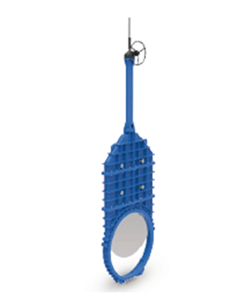
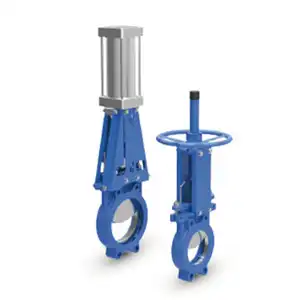
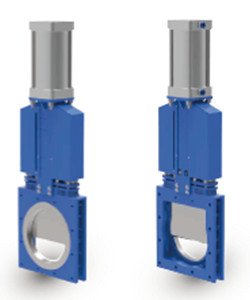
Product Description
The knife valve body does not have an actual cavity. The gate is lifted and lowered in the side guide groove and is pressed against the valve seat by the lug at the bottom. If medium to high tightness is required, an o-shaped valve seat can be used to create a two-way seal. The gate of a wedge knife gate valve can also be made into one; when it is modified in this way, it is called a rigid brake. Additionally, it is made into a brake that can produce slight deformation to improve its ability to process media and make up for the deviation of the sealing surface angle during processing; when it is modified in this way, it is called an elastic brake.
Most knife gate valves are self-sealing. When the knife gate valve is closed, the sealing surface can be sealed only by medium pressure. This occurs when the sealing surface of the gate is pressed against the valve seat on the other side of the gate to ensure the sealing of the surface. In the case of forced sealing, that is, when the valve is closed, it is necessary to rely on external force to seal the valve gate to the valve seat, ensure the tightness of the sealing surface. This type of knife valve should generally be installed vertically in the pipeline.
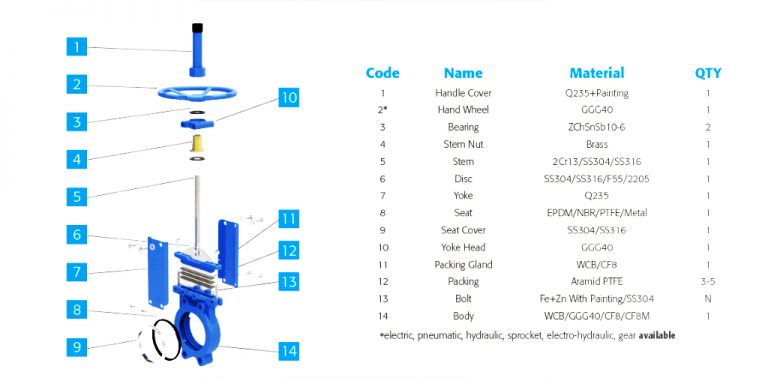
Knife Valve Structure
Product Features
Product Parameters
- The knife valve can be controlled locally or by remote. Remote position display and centralized control can be customized as required.
- Lightweight body- the body is composed of carbon steel, which is approximately 20%-30% lighter than traditional gate valves, making installation and maintenance easier.
- The knife valve can improve the performance of closing and sealing of the transportation pipeline system, prevent maximum leakage, and plays a positive role in improving production efficiency and environmental protection.
- The sealing surface is made of highly wear-resistant and corrosion-resistant ceramic materials. Mosaic technology has high corrosion and wear-resistance, extending the life of the valve and increasing cost-effectiveness.
| Standard | EN1092, MSS SP81, JIS 10K |
| Body Material | ductile iron (GGG40) or stainless steel (CF8, CF8M) |
| Connection | wafer type, lug type, or semi-lug type |
| Rate | PN10, Class 150, 10K |
| Seat | EPDM, Viton, Metal, PTFE, NBR |
| Operation | handwheel, pneumatic, electric, chain wheel, lever |
| Flange Standard | EN1092-2, BS10, T/E, T/D, MSS SP-81 |
| Inspection & Testing | BS EN 12266-1/AWWA C520 |
| Working Temperature | -20ºC to 100ºC(-4°F to 212°F) |
